


Restaurant operators, culinary directors, and hospitality procurement executives face a complex challenge when outfitting their teams: evaluating environmental claims without falling for greenwashing. When shopping for chef coats, kitchen aprons, and front-of-house workwear, buyers are routinely flooded with eco buzzwords like "green," "thoughtfully made," and "planet-conscious." In the commercial uniform sector, vendors frequently blur the line between independently audited environmental data and self-awarded marketing claims.
For hospitality groups expanding across regions or pursuing their own corporate ESG (Environmental, Social, and Governance) accreditations, choosing uniforms on vague marketing poses real risk. Unsubstantiated claims expose brands to supply-chain reputational damage and legal liability as international regulatory bodies clamp down on deceptive environmental marketing.
To offer a clear, fact-driven alternative to empty marketing, United Uniforms Global uses a thorough process to screen prospective vendors. Before adding an apparel manufacturer to its lineup, the company assesses production practices, the quality and traceability of materials, and each garment's ability to withstand repeated commercial laundering.
Drawing on in-depth technical reviews of four leading European apparel manufacturers, Le Nouveau Chef, Segers, Lafont, and Kentaur, this approach gives commercial buyers a dependable way to separate meaningful sustainability from marketing spin. Truly sustainable workwear demands more than persuasive hangtags. It requires scrutiny of independent certifications, fiber-composition documentation, and proven performance through years of industrial laundering.
1. Third-Party Verification vs. Brand Hype
In commercial apparel, independent third-party verification is the gold standard of environmental accountability. A certification carries genuine institutional weight when an accredited outside organization conducts rigorous physical audits and can revoke the mark for non-compliance. Standards such as B Corp, OEKO-TEX, and ISO 14001 are re-evaluated on strict renewal cycles, so operational standards do not slip over time.
Independent organizations verify certain sustainability claims, while others are made by brands about their own operations. Each can be useful, and it is important to tell them apart.
Recognizing that difference is no longer a matter of ethics alone. For commercial buyers, it is an essential way to reduce regulatory exposure:
- US FTC Green Guides. Environmental advertising claims must be supported by sound, reliable scientific evidence. The guides warn against sweeping, unqualified statements about environmental benefits.
- EU Directive 2024/825 (Empowering Consumers for the Green Transition). In effect from late September 2026, this directive bars broad environmental claims, such as "eco-friendly" or "climate neutral," unless they are backed by verified evidence of recognized environmental excellence. It also prohibits sustainability labels unless they are tied to an accredited independent certification program or issued by public authorities.
For hospitality groups operating across multiple properties, sourcing uniforms certified through recognized programs helps safeguard supply-chain integrity before these requirements take hold. Segers' OEKO-TEX MADE IN GREEN certified garments are one example of documented transparency. Rather than a general eco-label, the certification provides a unique, traceable label ID that lets procurement teams verify the specific manufacturing sites certified for each garment.
2. Durability is Sustainability
In high-intensity kitchens and dining rooms, industrial laundering life and structural durability are primary environmental metrics, not operational footnotes. Tensile strength, colorfastness, and seam integrity carry as much ecological weight as raw fiber selection.
Consider the baseline math of garment longevity: a high-performance chef coat that holds its structural integrity across three years of commercial washing replaces three lower-grade coats that break down after a single season. Extending a garment's service life cuts manufacturing volume, shipping fuel, packaging waste, and textile landfill burden at the source.
The greenest coat is the one you do not have to replace.
To validate performance before garments reach the line, leading manufacturers rely on standardized industrial wash protocols rather than internal estimates. Segers, for one, tests the majority of its workwear line against ISO 15797, the international standard for industrial laundering evaluation. Framing garment lifespan around recognized ISO wash ratings gives procurement teams a reliable benchmark for extended service. Our chef coat fabric guide breaks down how wash temperature and fiber content drive that service life.
This focus on physical durability delivers a direct financial return. When uniforms hold their color, fit, and professional finish through aggressive wash cycles year after year, hospitality operations achieve both a reduced lifetime environmental footprint and a lower Total Cost of Ownership (TCO). For financial controllers managing linen contracts and uniform lease agreements, investing in ISO-tested durability turns a recurring operational expense into a strategic, cost-saving asset.
3. Inspect Fiber Specs, Not Hangtag Adjectives
General marketing terms on a hangtag offer commercial buyers almost no actionable data about a garment's environmental impact. Instead of vague descriptors like "sustainable cotton" or "eco-weave," procurement specialists should examine technical fiber spec sheets to verify exact low-impact fiber percentages and material origins.
Leading European uniform manufacturers use advanced material engineering to reduce reliance on virgin petrochemicals and resource-intensive agriculture:
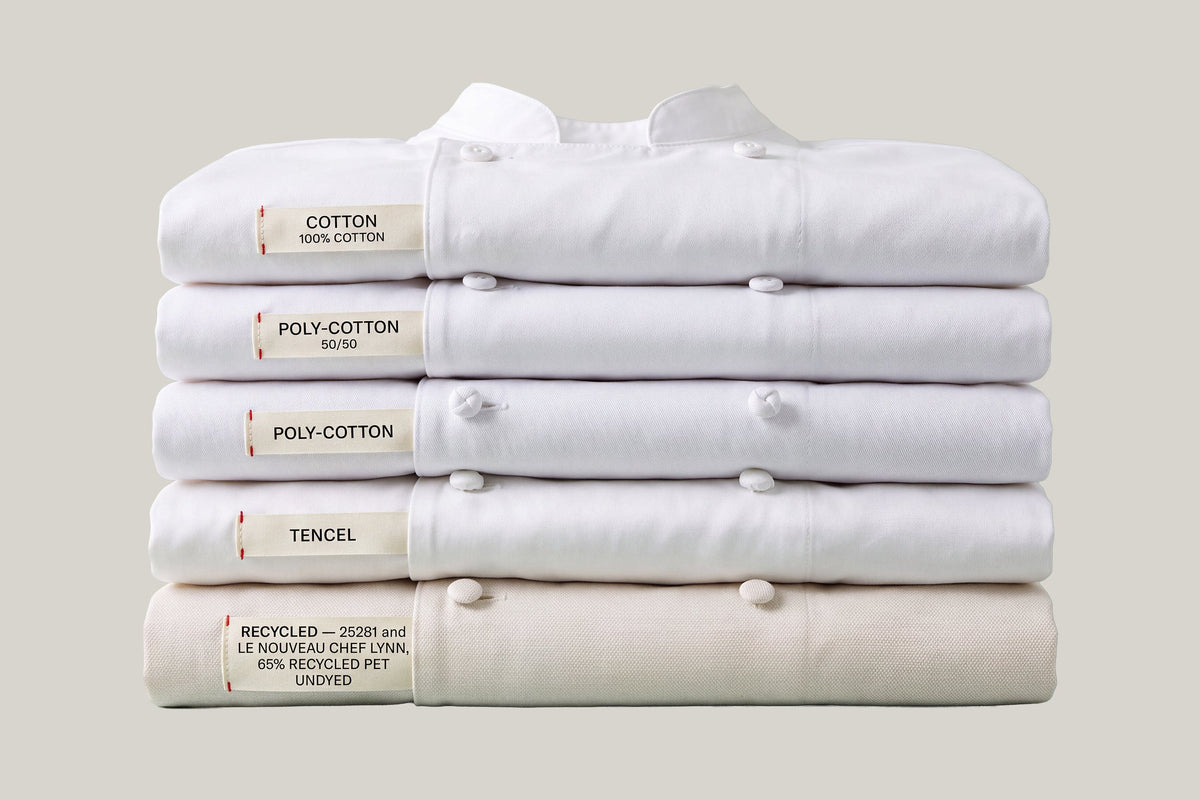
- Recycled PET polyester. Global Recycled Standard (GRS) certified recycled polyester, derived from post-consumer PET bottles, diverts synthetic waste from landfills and oceans while lowering carbon emissions compared with virgin polyester. Segers integrates GRS-certified REPREVE recycled polyester across its core line. Le Nouveau Chef's Lynn women's jacket carries a blended composition of 65% recycled PET and 35% lower-impact cotton in its core colorways, such as Black, Undyed, Olivette, and Stone, with specialized colorways like White requiring separate composition verification.
- Lyocell and reclaimed fiber technologies. Wood pulp-derived lyocell offers a closed-loop, low-water alternative to conventional synthetic and natural fibers. Pushing circular textile engineering further, Kentaur uses TENCEL lyocell with REFIBRA technology. The process reclaims post-industrial cotton scraps, upcycling manufacturing waste into new lyocell fiber, which is then blended with recycled PET polyester. By demanding and scrutinizing exact fiber percentages on specification sheets, buyers eliminate guesswork and anchor their decisions in verifiable textile engineering.
4. Real Data Beats Slogans: B Corp Scores, EcoVadis Gold, and Footprint Audits
Verified numerical scores, published lifecycle metrics, and accredited social-compliance audits separate genuine sustainability leaders from superficial marketing. A manufacturer that systematically measures and publishes its operational footprint gives commercial buyers the data required for internal ESG accounting. The quantitative records of Europe's top four uniform makers show how transparent data replaces broad corporate marketing:
- Le Nouveau Chef. Holds a verified B Corporation certification awarded by the independent non-profit B Lab, with an audited overall score of 111.1. That score stands well above B Lab's 80-point qualification threshold and the 51.0 median for typical audited businesses. Le Nouveau Chef manufactures its line within Europe and has legally codified its social and environmental mission into its corporate articles of association.
- Lafont (CEPOVETT Group). Earned an independent EcoVadis Gold ESG rating in 2025 with an overall score of 77 out of 100, placing the parent group in the top tier of evaluated companies globally across environment, labor standards, ethics, and sustainable procurement.
- Kentaur. Publishes detailed Product Environmental Footprint (PEF) data across its core line alongside an annual responsibility report. Kentaur openly prioritizes documented lifecycle data over generic claims, while noting that specific garment-level certifications remain pending final verification.
- Segers. Operates certified ISO 14001 environmental management systems and conducts independent amfori BSCI social-compliance audits at its key manufacturing sites to help ensure ethical working conditions.
Framing Your Uniform Strategy for the Long Haul
A genuinely sustainable commercial uniform program requires looking past market hype, promotional slogans, and eco-friendly packaging. By placing industrial laundering durability, raw material spec sheets, third-party verification, and regulatory compliance at the center of procurement decisions, hospitality leaders can shape a high-performing workwear strategy that delivers measurable environmental and financial value. Our guide to building a complete restaurant uniform program puts that decision in sequence with the rest of the buy.
A durable chef coat engineered to survive years of industrial washing lowers Total Cost of Ownership while eliminating textile waste at the source. As enforcement under the FTC Green Guides and EU Directive 2024/825 tightens worldwide, grounding procurement in audited numbers and transparent supply-chain data is the reliable way to protect your organization against greenwashing risk.
Next step for buyers: when assessing your existing workwear program, ask your procurement team one question. Do your uniform suppliers offer independently audited specifications and validated laundering standards, or are you paying extra for unverified marketing language on a hangtag?
See how we apply this standard on our How We Vet for Sustainability page.

Share:
Chef Coat Fabric Guide: Cotton, Poly-Cotton, Tencel, and Recycled Blends